Quote Assumptions, Exclusions, and Change Orders
Learn how upholstery shops write quote assumptions, exclusions, and change-order terms that keep hidden repair, material, scope, and customer approval risks clear.
Learning Objectives
- Explain why an upholstery quote must separate included work, assumptions, exclusions, and change-order triggers.
- Write assumptions that protect the customer and shop when hidden conditions are unknown.
- Identify exclusions that should be stated before deposit or material ordering.
- Use teardown evidence to request approval before extra work continues.
Metro Vancouver upholstery project?
If the furniture is in Metro Vancouver, send project photos for a local reupholstery quote. For general upholstery research, keep using the handbook.
An upholstery quote is not just a price. It is the written boundary around the work the shop has agreed to do. The best quotes make the job easier to understand before money changes hands: what is included, what the price assumes, what is excluded, and what will require approval if teardown changes the evidence.
That boundary matters because upholstery hides work. A chair can look simple while concealing broken spring clips, failed webbing, rotted padding, old repairs, or frame movement. A sofa can be quoted in a plain fabric and later selected in a large-repeat fabric that changes yardage and labour. A quote that does not name assumptions can make normal hidden-condition work feel like a surprise.
The quote should be written so it can survive teardown. If the cover comes off and the evidence changes, the quote should already explain what happens next.

change-order evidence
What belongs in the quote
A strong upholstery quote should be specific enough that another competent shop person can understand the job without guessing what was promised.
| Quote element | What it should say | Why it matters |
|---|---|---|
| Included work | The visible work the price covers: recover, cushion work, standard welt, underside finish, pickup, delivery, or documented repairs. | Prevents the price from being read as "everything the furniture could possibly need." |
| Assumptions | Conditions the price depends on: no frame repair, no spring repair, plain fabric, standard foam reuse, normal access, or available supplier stock. | Makes uncertainty visible before teardown or ordering. |
| Exclusions | Work not included unless approved: structural repair, refinishing, pest or odour remediation, major cushion rebuild, special trim, or compliance documentation. | Protects the customer from unclear extras and protects the shop from absorbing unrelated work. |
| Change-order triggers | What events pause the job for approval: broken support, distorted cushion core, fabric shortage, hidden damage, or customer design change. | Creates a clear decision point instead of an argument after work starts. |
| Evidence record | Photos, measurements, fabric details, supplier notes, and customer approvals. | Shows why the quote was reasonable when it was written. |
Quote Change Order Path
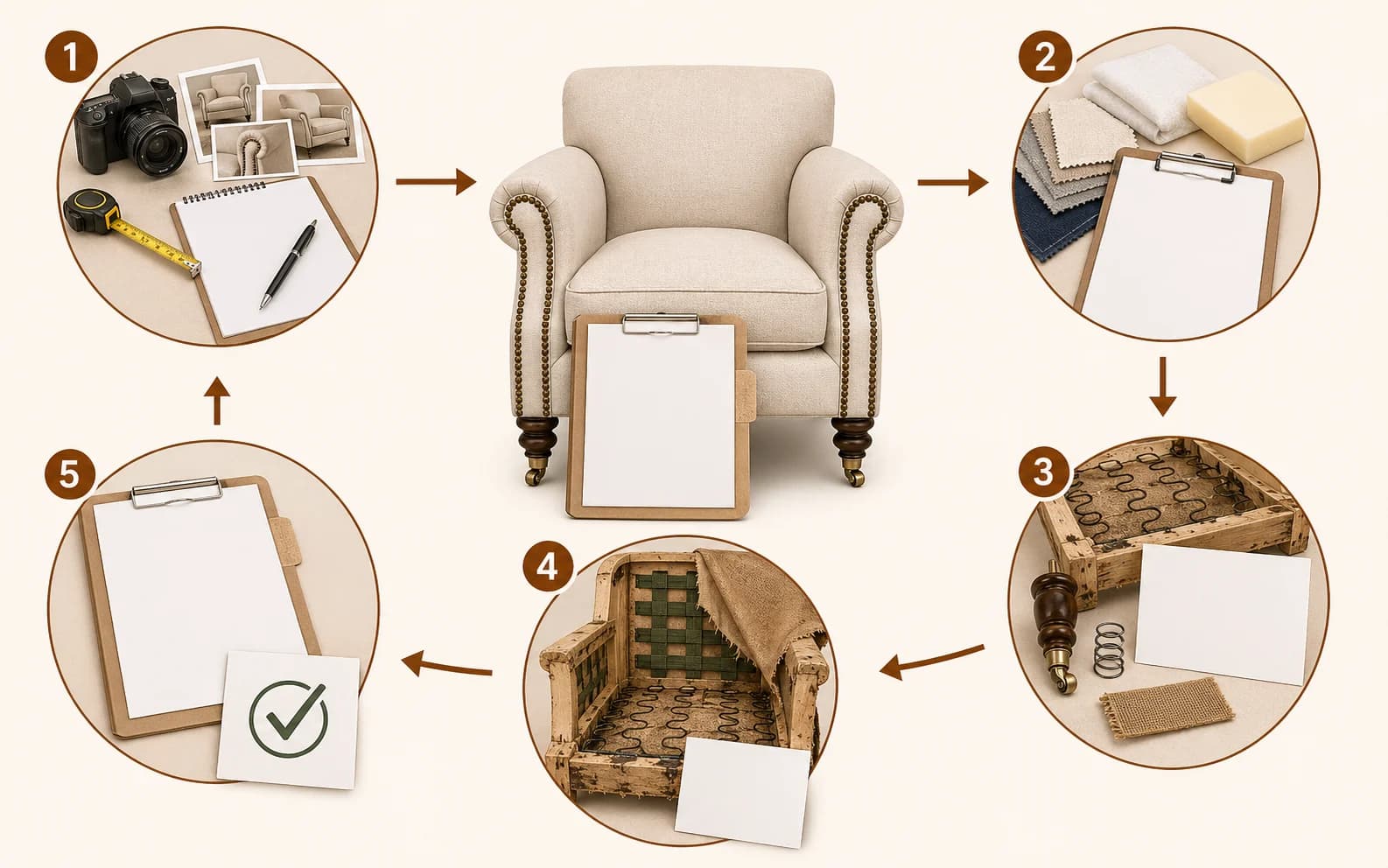
- 1Intake evidencePhotos, dimensions, fabric choice, condition notes, and customer goals establish the first quote boundary.
- 2Written assumptionsState what the price depends on, such as serviceable support, plain fabric, normal removal, or available stock.
- 3Exclusions and limitsName work outside the price before deposit, including structural repair, cushion rebuilds, refinishing, or special documentation.
- 4Teardown findingWhen hidden support, frame, material, or cushion evidence changes the scope, pause and document it.
- 5Approved change orderContinue changed work only after the customer has approved cost, schedule, and performance tradeoffs.
A quote is a scope document
The quote should answer three questions before work begins: what is being done, what is not being done, and what evidence could change the work. When those questions are answered clearly, a change order becomes a planned decision point instead of a surprise invoice.
Good quote language is concrete. "Recover chair in customer-selected fabric with standard self-welt and black dust cover" is clearer than "upholster chair." "Excludes frame repair, spring repair, cushion replacement, and refinishing unless approved after teardown" is clearer than "extra work not included."
Assumptions are not excuses
An assumption is a professional statement of what the shop believes based on the evidence available. It should be concrete. "Assumes no frame repair" is useful. "Hidden issues may cost more" is too vague unless the quote explains what kinds of issues would change the scope.
Good assumptions are tied to inspection limits. A remote quote from photos may assume the underside, support, and cushion interiors are serviceable because they have not been inspected. An in-shop quote may assume the fabric selection remains a plain 54-inch upholstery fabric with no repeat matching. A quote written before teardown may assume the old cover can be removed normally and that hidden materials do not require special handling.
When the evidence changes, the assumption either holds or fails. That is the point of writing it down.

quote assumption review
Assumptions should be testable
An assumption is useful only if the shop can later say whether it remained true.
| Weak wording | Better wording |
|---|---|
| Hidden issues extra | Assumes frame, webbing, springs, and cushion core are serviceable until teardown shows otherwise. |
| Standard fabric included | Assumes plain 54-inch upholstery fabric with no repeat matching, nap direction, leather/hide planning, or supplier restrictions. |
| Foam as needed | Includes cushion wrap only; foam replacement requires approval after insert inspection. |
| Repairs included | Includes minor tack-line cleanup only; structural frame, spring, clip, or rail repair is excluded unless approved. |
| Customer changes may cost more | Changes to fabric, trim, welt, cushion fill, delivery, or schedule may revise labour, material, and completion date. |
The better wording gives both sides a way to evaluate the job when evidence changes.
Exclusions should be plain, not defensive
Exclusions are not a way to avoid responsibility. They are a way to keep the scope honest. If the customer is paying for a recover, they should know whether frame repair, foam replacement, spring work, refinishing, stain removal, fabric protection, or future service fabric is included.
The language should be direct. "This quote excludes frame repair unless approved after teardown" is better than a long legal sentence. "Customer-selected fabric may change yardage, labour, and schedule if it has repeat, nap, directional pattern, limited stock, or supplier restrictions" tells the customer what could change and why.
For limited-budget work, exclusions are especially important. A customer may choose cosmetic recover work while declining cushion or support correction. That can be an acceptable scope if the quote explains the remaining risk: the piece may look renewed without feeling or performing like a full rebuild.
Change orders start with evidence
A change order should not begin with "this costs more." It should begin with what changed: a photo of broken springs, a note that the cushion core collapsed after the cover came off, supplier confirmation that the selected fabric is short-stocked, or a customer request to add contrast welt after the original quote.
Once the evidence is clear, the shop can state the option, cost, schedule impact, and approval point. The work should not continue into the changed scope until the customer has made a decision.
Worked case: the recover that becomes support repair
A customer approves a chair recover based on photos and a fabric selection. The quote includes removal, new cover, standard self-welt, underside finish, and delivery. It assumes no frame or spring repair because the support was not visible in the original photos.
During teardown, the shop finds broken spring clips and a cracked front rail. The wrong response is to repair it quietly and invoice later, or to ignore the support problem and keep the original price. The correct response is to photograph the condition, explain why the recover will not perform properly without support repair, and offer a change order before continuing.
A clear customer explanation is: "The fabric work is still the same, but teardown revealed support damage that was not visible in the original quote. We can proceed with the recover only after deciding whether to repair the support. If declined, the finished chair may still sag or move because that problem is outside the cover work."
Worked case: fabric choice changes the quote
A customer receives a quote based on a plain fabric estimate, then selects a large-repeat patterned fabric with directional nap. The furniture has wings, boxing, welt, and a loose cushion. The original labour and yardage assumptions no longer match the selected material.
The shop should not absorb the change silently or cut the fabric using the original assumption. The quote should be revised to explain the repeat, direction, matching priority, added yardage, and added labour. The customer can then choose exact matching, selective matching, or a different fabric.
This is still a change order even though the frame did not reveal hidden damage. Customer choices can change scope too.
Change-order sequence
Use the same sequence every time:
- Stop before the changed work continues.
- Photograph or describe the evidence.
- Connect the evidence to the original assumption or exclusion.
- State the option, cost, schedule impact, and performance tradeoff.
- Get approval or declined-scope confirmation.
- Keep the decision with the job file.
The sequence should feel calm. The shop is not asking for permission after the fact; it is making the next step visible before the work is hidden.
Customer-friendly quote structure
A quote can be protective without sounding legalistic. The structure should help the customer understand the job quickly, then give enough detail for the shop to rely on later. A practical order is:
- Job description: the piece, room, customer name, fabric selection status, and visible goal.
- Included work: removal, recover, sewing details, cushion work, support work, trim, pickup, delivery, and finishing items that are actually included.
- Material assumptions: fabric width, repeat, nap, leather or vinyl handling, foam, batting, thread, trim, and supplier availability.
- Hidden-condition assumptions: frame, springs, webbing, cushion core, padding, odour, contamination, and prior repairs.
- Exclusions: work outside the price unless approved.
- Change-order process: when work pauses, what evidence is shown, how approval is recorded, and how cost or schedule changes are handled.
This order keeps the quote readable. The customer sees the work first, then the boundaries. The shop still gets a record that can guide teardown, ordering, and handoff.
Declined work and warranty limits
Sometimes the customer sees the evidence and declines the recommended repair. That decision can be legitimate, but it must be recorded clearly. A customer may choose a cosmetic recover without rebuilding a cushion core, may decline frame repair on a low-budget piece, or may accept limited pattern matching to stay within budget.
The quote or change order should state the consequence of that decision in plain language. If support repair is declined, the finished piece may still sag or move. If cushion replacement is declined, the cover may look new while the seat remains soft, uneven, or compressed. If fabric protection, extra yardage, or future-service material is declined, later service may be harder to match.
Warranty language should follow the accepted scope. The shop should stand behind the work it performed, but it should not imply warranty coverage for conditions the customer declined to repair. A useful note is: "Recover workmanship is covered under the shop policy; pre-existing support condition remains outside the repair scope because support repair was declined." That is direct and fair.
Material and schedule changes are scope changes
Hidden damage is not the only reason a quote changes. Material and schedule choices can change the job just as much as a cracked rail. A fabric substitution may add repeat matching. A rush deadline may require different scheduling. A customer may add contrast welt, nailheads, cushion upgrades, or delivery requirements after the original quote.
These should be treated as scope changes, not casual adjustments. The shop should explain whether the change affects yardage, labour, supplier timing, cost, completion date, or warranty expectations. If it does not affect those things, the record can say so. If it does, the customer should approve the revised scope before the shop orders material or performs the extra work.
This habit keeps the quote useful after deposit. It also prevents a slow drift from one job into another without anyone deciding where the new boundary sits.
Common mistakes
- Writing a quote as a single price with no included work, assumptions, or exclusions.
- Using vague phrases like "standard repairs included" without saying which repairs are standard.
- Treating every hidden condition as the customer's fault rather than explaining the inspection limit upfront.
- Continuing into extra repair work before documenting the evidence and getting approval.
- Excluding too much in defensive language that makes the quote hard for the customer to trust.
- Forgetting that customer changes, fabric changes, supplier shortages, and schedule changes can be change orders too.
What to document
- The quote version the customer approved.
- Photos and measurements that support the original assumptions.
- Included work, exclusions, and conditional work.
- Fabric, foam, supplier, delivery, and schedule assumptions.
- Hidden findings or customer changes that triggered a change order.
- Approval or declined-scope notes before changed work continued.
Final quote review before deposit
Before taking a deposit or ordering non-returnable material, review the quote as if another person will have to run the job from the file. The review should answer:
- Can the included work be identified without relying on memory?
- Are the assumptions specific enough to test during teardown, ordering, and production?
- Are exclusions written plainly enough that the customer can make an informed decision?
- Does the quote explain what happens when hidden damage, fabric choice, supplier stock, customer changes, or schedule pressure changes the scope?
- Are photos, measurements, material notes, and customer approvals attached to the same job record?
- Does the warranty language match the work actually included?
If the answer is no, the quote is not ready. Tightening the language before deposit is faster than repairing trust after the job has already changed.
The finished standard is a quote that can survive the moment the cover comes off. It should tell the customer what they approved, what the shop assumed, what remains outside the price, and what happens when the furniture reveals new evidence. When that structure is clear, change orders become part of honest craft work rather than a surprise added at the end.
Knowledge Check
Pass this check to complete the lesson.
Answered 0/4.
Question 1
A remote chair quote assumes no spring repair because the underside was not visible. Teardown reveals broken spring clips. What should happen next?
Question 2
Which quote wording is the clearest assumption rather than a vague warning?
Question 3
A customer chooses a limited cosmetic recover and declines cushion rebuilding. What should the quote do?
Question 4
A customer asks to add contrast welt after fabric has been ordered and cutting planned. Why can this be a change order?
Have a local piece ready for reupholstery?
For Metro Vancouver sofas, chairs, cushions, or commercial seating, mention "Quote Assumptions, Exclusions, and Change Orders" with your photos so we can price the actual work accurately.