Measuring Furniture and Estimating Yardage
Learn how upholstery shops estimate fabric yardage from furniture measurements, panel layout, repeat, nap, railroad direction, matching, and cutting waste.
Learning Objectives
- Measure furniture in a way that supports cutting, sewing, matching, and quote assumptions.
- Explain why yardage is not the same as visible surface area.
- Account for repeat, nap, railroad direction, welt, skirts, cushions, damage, and contingency.
- Document yardage assumptions before the customer approves fabric or deposit.
Metro Vancouver upholstery project?
If the furniture is in Metro Vancouver, send project photos for a local reupholstery quote. For general upholstery research, keep using the handbook.
Yardage is a layout problem, not a surface-area problem
Measuring furniture for upholstery is not the same as measuring a box. The shop is not buying the visible surface area of the chair; it is buying fabric that must be cut into usable panels, turned around corners, sewn with allowances, matched at important lines, and pulled over padding without running short.
That is why two chairs of similar size can need different yardage. A plain fabric on a simple cushion chair may cut efficiently. A large-repeat fabric on a channel back, skirted base, boxed cushions, and welt may need more fabric because the layout has to respect direction, matching, and waste. Yardage is the bridge between the measurement record and the cutting table.

measurement setup
Measure for the pieces you will cut
A useful measurement record describes the furniture as panels and decisions, not just height and width. Start with the whole object, then break it into the parts that will be cut or matched.
| What to measure | Why it matters | What to record |
|---|---|---|
| Overall height, width, and depth | Establishes scale, delivery access, and rough fabric category. | Front, side, and back dimensions with photos. |
| Seat, inside back, outside back, arms, and base | These become separate panels with different stretch, direction, and pull behavior. | Width, height, depth, curve, and whether old covers are distorted. |
| Cushions | Boxed cushions, bullnose cushions, loose seats, backs, zippers, and wrap affect panel count. | Top, bottom, boxing, zipper, crown, and whether cushions should be mirrored or matched. |
| Welt, skirts, buttons, channels, and trim | Small details can consume surprising yardage and labour. | Linear feet, placement, direction, and whether the same fabric or contrast fabric is used. |
| Pattern, nap, and direction | The fabric may have a correct top, pile direction, or repeat that controls layout. | Repeat size, railroad direction, face direction, and visual priority lines. |
| Damage and defects | Old fabric may be stretched; new fabric may contain flaws; extra is needed for correction. | What cannot be trusted from the old cover and what contingency is included. |
Yardage Layout Factors
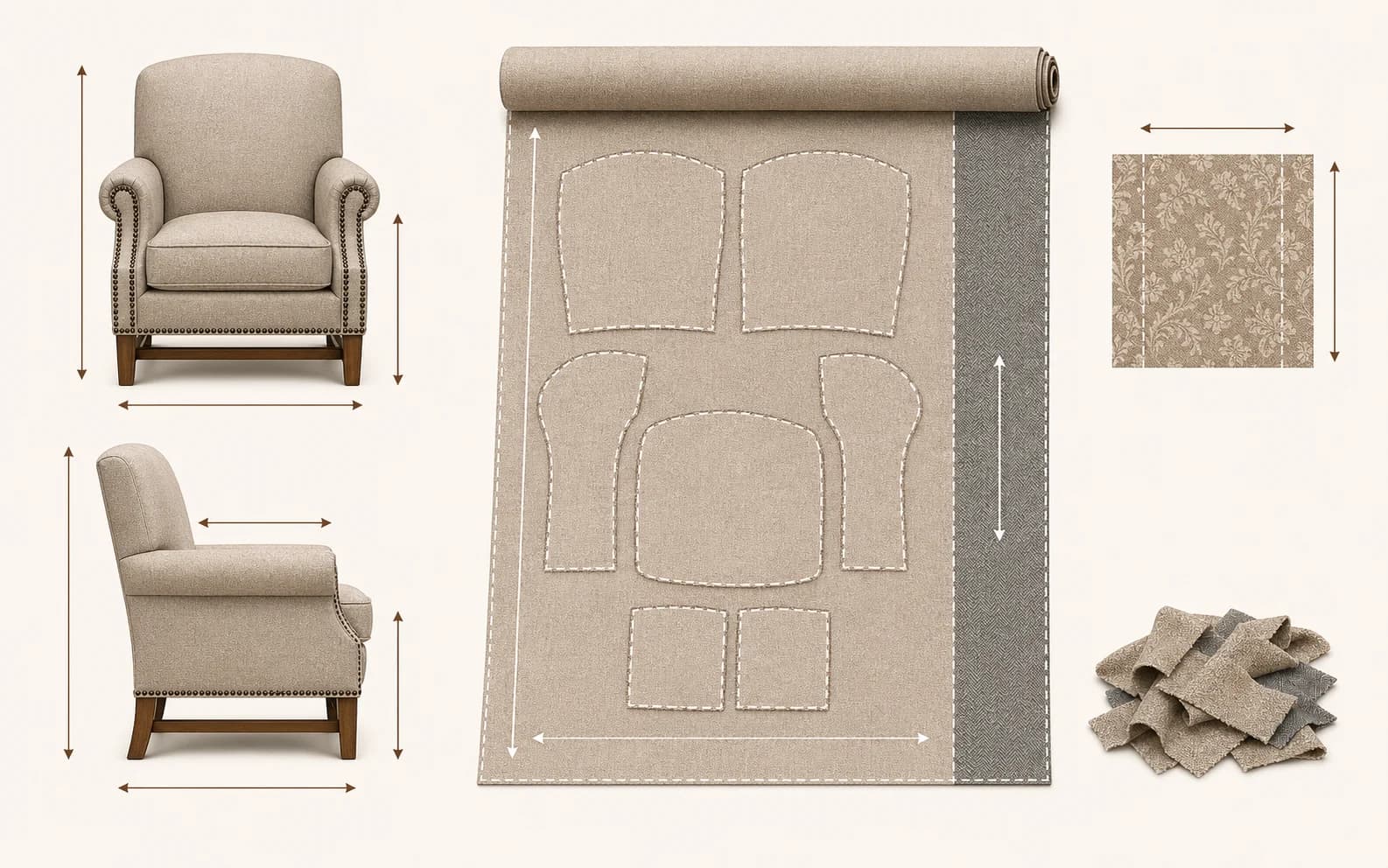
- 1Furniture measurementsMeasure the whole piece and the panels that will actually be cut: back, arms, cushion, base, boxing, and outside areas.
- 2Panel layoutYardage depends on how panels fit on the fabric width, not only on the visible chair surface.
- 3Pattern repeatLarge motifs may need centering and matching, which creates waste between panels.
- 4Nap directionPile, texture, and face direction can prevent panels from being flipped to save fabric.
- 5Waste and contingencyAdd allowance for flaws, recuts, welt, skirt strips, zipper panels, and future service needs.
The yardage variables that change the number
Plain surface measurements are only the starting point. The final yardage estimate changes when the fabric or furniture imposes layout rules.
| Variable | How it changes yardage | Example |
|---|---|---|
| Pattern repeat | Panels may need to start at matching points rather than wherever they fit most efficiently. | Centering a floral motif on the inside back and cushion may add waste. |
| Nap or pile | All visible panels may need to run in the same direction. | Velvet, chenille, or raised textures can shade differently if flipped. |
| Railroad direction | Fabric width may be used across the furniture instead of up the roll, or the reverse may be required. | A sofa deck may cut efficiently railroaded, while a tall chair back may not. |
| Matching priority | The shop may choose which lines must match and which lines can be less exact. | Cushion-to-front apron match may matter more than underside pieces. |
| Cushions and welt | Boxing, zipper panels, top/bottom plates, and welt add fabric beyond the visible seat face. | Two loose cushions with self-welt can use much more than a tight seat. |
| Skirts, channels, tufting, and buttons | Repeated details multiply small pieces and alignment decisions. | A skirted chair may require long continuous strips and pattern control. |
| Contingency | Extra fabric protects against flaws, cutting errors, supplier variation, and future repair. | Ordering exactly the mathematical minimum leaves no recovery room. |
Use old covers carefully
Old covers can teach the cutting logic, but they should not be treated as perfect patterns. Fabric may have stretched, shrunk, torn, distorted around failed foam, or been cut poorly during an earlier repair. If the old cover was already wrong, copying its yardage logic can repeat the mistake.
Use old pieces to identify panel count, seam positions, boxing width, zipper placement, and matching intent. Then compare them against the furniture frame and new material behavior. A new fabric with less stretch, larger repeat, heavier backing, or different nap may need a different layout even when the furniture has not changed.

yardage layout review
Review yardage against the layout
The safest yardage review happens before ordering, not while the fabric is already on the table. Sketch the major panels and mark which ones are visible, directional, mirrored, matched, railroaded, or allowed to be less controlled. Then compare that sketch with fabric width, repeat, nap, defects, welt, boxing, zipper strips, and contingency.
This does not need to become a full production marker for every small job. It does need to catch the expensive mistakes: a tall back that cannot fit across the width, a cushion pair that needs mirrored pattern placement, a skirt that needs long continuous strips, or a fabric with nap that cannot be flipped to save yardage. A few minutes of layout thinking can prevent a shortage that stops production.
For customer-supplied fabric, measure the actual usable yardage. Do not rely only on what the customer says is on the roll. Check width, flaws, cut ends, fading, odour, and whether the roll contains one continuous length or several pieces. If the shop accepts a short or risky fabric, write down the limitation before cutting.
Worked case: the large-repeat chair
A customer chooses a large-pattern fabric for a chair originally quoted in a plain fabric. The chair has a tall inside back, loose cushion, outside arms, outside back, and self-welt. The surface dimensions have not changed, so it is tempting to keep the original yardage.
The better estimate starts with layout. The inside back needs the pattern centered. The cushion top should relate visually to the back. The arms should not show obvious mismatched motif placement at normal viewing angles. Welt cut from the same fabric may need bias or straight strips depending on the shape and fabric behavior. The result is not just more material; it is a different cutting plan.
The customer explanation is simple: "The chair size is the same, but the fabric repeat changes how the pieces can be cut. We need extra yardage so the visible panels can be placed intentionally instead of wherever they happen to fit."
Put the assumption in the quote
Yardage should be written as an assumption, not as a magic number. If the estimate assumes plain 54-inch fabric, no repeat matching, no skirt, standard self-welt, or no hidden defects, say so. If the customer later chooses a patterned fabric or asks for extra welt, the shop has a documented reason to revisit yardage before ordering.
For remote quotes, use ranges when the evidence is incomplete. For in-shop estimates, keep the measurement sheet with the job file so another upholsterer can understand why the yardage was ordered. Yardage errors are expensive because they can stop production, force compromises, or leave no fabric for future repairs.
Where yardage and labour meet
Yardage decisions affect labour. Pattern matching takes time. Directional cutting takes discipline. Thick backed fabric may slow sewing and corner handling. Leather, vinyl, and coated textiles require yield thinking instead of simple roll yardage. Even a plain fabric can create labour if the old cover is distorted and the shop has to true the pattern from the frame rather than copying the old pieces.
The quote should reflect that relationship. A simple yardage number is incomplete if the selected fabric changes layout and handling. If the customer switches from a plain weave to a large-repeat fabric, the shop should revisit both fabric quantity and labour. If a designer asks for exact motif placement, the estimate should include the time and extra material needed to achieve it.
This is where customer communication matters. "We need more fabric" can sound arbitrary. "The repeat has to be centered on the inside back and related to the cushion, so the pieces cannot all be nested tightly" is understandable. The customer may still choose the fabric, but they are approving the real cost of that choice.
Apprentice shop standard
Apprentices should be trained to measure twice: once as furniture and once as cut pieces. The first measurement gives scale. The second exposes panel count, boxing, welt, repeat, nap, and waste. If they skip the second pass, they are estimating from the wrong object.
They should also learn when not to trust the old cover. A stretched cushion top, torn boxing, previous repair patch, or collapsed foam can all distort the piece being measured. The better reference may be the frame, the cushion core, the intended crown, and the new fabric's behaviour.
Common mistakes
- Estimating from surface area without converting the furniture into cut panels.
- Ignoring pattern repeat, nap, railroad direction, or matching priorities until after fabric is selected.
- Forgetting welt, boxing, skirt strips, zipper panels, buttons, or underside pieces.
- Trusting old covers as exact patterns when they are stretched, shrunken, or previously repaired.
- Ordering the mathematical minimum with no allowance for defects, recuts, or future service.
- Giving a firm yardage number before the fabric choice and visual matching standard are known.
Final yardage check
Before ordering, confirm the fabric width, repeat, direction, nap, panel list, welt, boxing, zipper strips, skirt or trim, contingency, and whether the customer expects matching beyond the shop's normal standard. If fabric is customer supplied, confirm usable length and document any shortage or defect risk.
The final yardage note should be clear enough that the cutter understands the estimate. If the measurement sheet cannot guide cutting decisions, it is only a rough size note, not a finished yardage estimate.
For patterned or directional fabric, record the visual priority. The shop may center the inside back, align cushion tops, control the front apron, or accept looser matching on hidden or low-view panels. Without that priority, two upholsterers can order the same yardage and make different cutting decisions. The customer should approve the standard that affects both material and labour.
For leather, vinyl, and coated textiles, replace yardage thinking with yield thinking where needed. Hide shape, defects, stretch direction, grain, backing, coating, and panel size can matter more than a roll-length formula. The quote should say when the estimate depends on supplier yield, hide selection, or inspection after material arrives, and the customer should understand that a material substitution can reopen the estimate before cutting, not after the shortage is discovered on the production table during final layout and sewing.
The finished standard is a yardage estimate that can survive the cutting table. It should show the furniture measurements, the panel logic, the fabric assumptions, the matching priorities, and the contingency. A good estimate does not merely answer "how big is the chair?" It answers whether the chosen fabric can be cut into the finished upholstery the customer expects.
Knowledge Check
Pass this check to complete the lesson.
Answered 0/4.
Question 1
A customer chooses a large-repeat fabric after the chair was roughly estimated in a plain fabric. What should happen before ordering?
Question 2
Why is visible surface area alone a weak way to estimate upholstery yardage?
Question 3
An old cushion cover has stretched badly around collapsed foam. How should it be used for measuring?
Question 4
A quote assumes plain 54-inch fabric with no repeat, but the customer has not chosen fabric yet. What should the written quote say?
Have a local piece ready for reupholstery?
For Metro Vancouver sofas, chairs, cushions, or commercial seating, mention "Measuring Furniture and Estimating Yardage" with your photos so we can price the actual work accurately.