Repeatability and Templates for Production Upholstery
Learn how upholstery shops use templates, first-article fitting, batch notes, and quality checks to make repeated seats and panels match across production work.
Learning Objectives
- Explain why a template is a control record, not merely a faster way to cut fabric.
- Identify which measurements, grain marks, seam allowances, and build notes must be preserved for repeated upholstery work.
- Use a first-article fit to catch errors before a whole batch is cut or covered.
- Judge repeated seats or panels against a shared acceptance standard rather than individual appearance.
Metro Vancouver upholstery project?
If the furniture is in Metro Vancouver, send project photos for a local reupholstery quote. For general upholstery research, keep using the handbook.
Templates Preserve Decisions
A template is often described as a production shortcut, but in upholstery it is closer to a shop record. It preserves the shape of the original cover, the direction of the fabric, the allowance that disappeared inside a seam, the foam crown that changed the pull, and the small corrections that made the first piece fit.
That matters most when the work repeats: restaurant seats, dining chair sets, banquettes, matching cushion runs, hotel pieces, theatre pads, modular panels, or any job where the customer expects several pieces to agree. One well-made seat is not enough. The fifth, tenth, or twentieth piece must still look like it belongs to the same set.

before/detail
What the Template Must Carry
Templates fail when they capture only the outline. A usable production template carries the information another upholsterer would need to repeat the decision without guessing.
| Template record | What it controls | What can go wrong if it is missing |
|---|---|---|
| Original orientation | Left/right position, face side, and front edge | Pieces are cut mirrored, rotated, or pulled against the intended shape. |
| Grain or nap direction | How fabric stretches, reflects light, and wears | Matching seats look different even when the pattern is technically the same. |
| Seam allowance | The hidden material needed for sewing and pulling | Covers finish too small, seams ride high, or corners become bulky. |
| Foam and wrap notes | Crown height, edge profile, and batting thickness | A correct cover is blamed for a cushion shape problem. |
| Fastener and pull sequence | Which edge is fixed first and where tension is balanced | Repeated pieces develop different wrinkles or seam drift. |
| Batch standard | What amount of variation is acceptable | Each piece is judged in isolation instead of against the set. |
The old cover is useful evidence, but it is not automatically the standard. If the old cover stretched, shrank, tore, or was repaired badly, the template should record both the evidence and the correction.
Repeatability Workflow
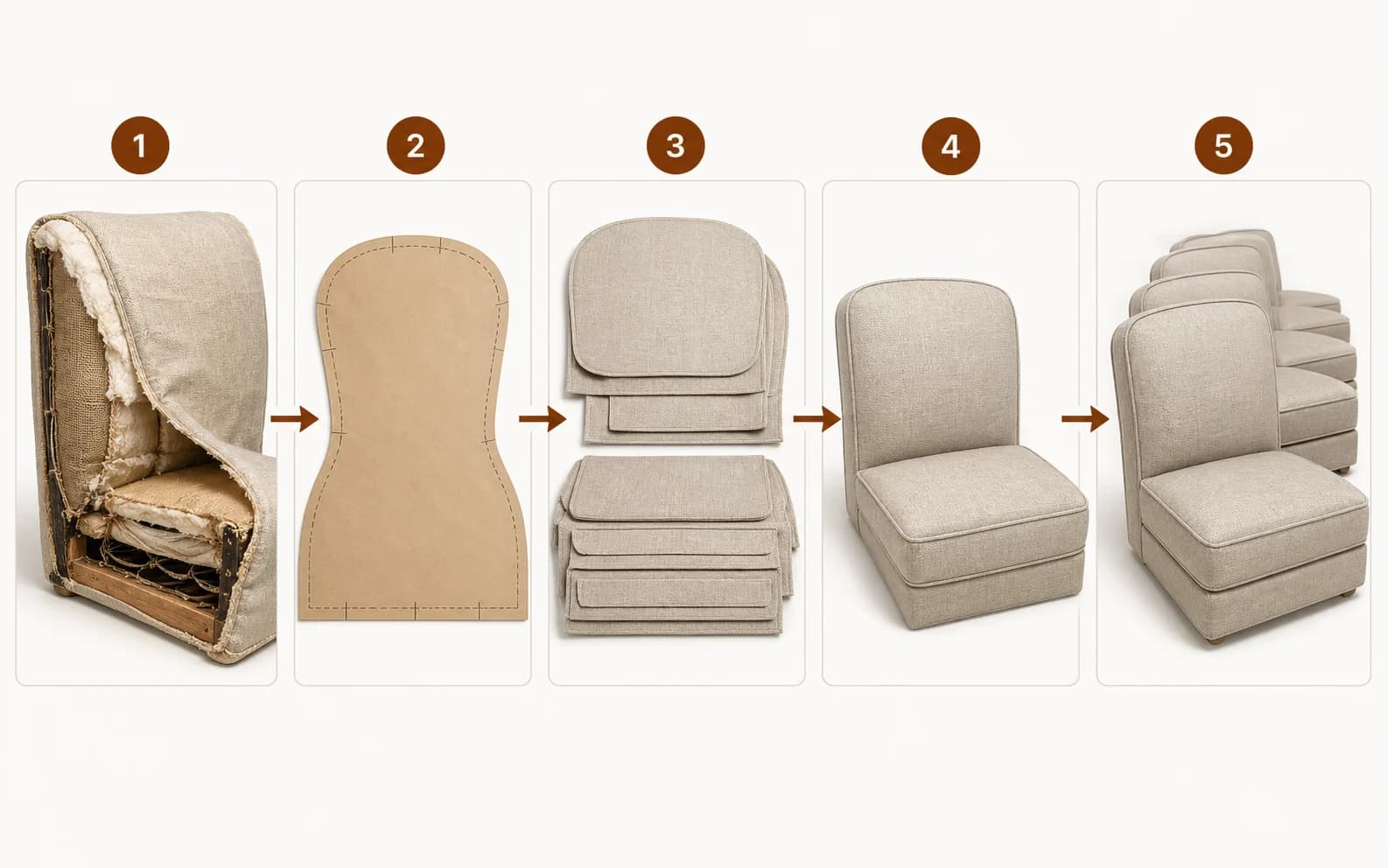
- 1Read original cover evidence before tracingUse this step to read original cover evidence before tracing before the next decision.
- 2Make a corrected template with direction and allowancesCheck make a corrected template with direction and allowances before choosing the next step.
- 3Cut repeated pieces from the same control recordCheck cut repeated pieces from the same control record before choosing the next step.
- 4Prove the first article before finishing the batchCheck prove the first article before finishing the batch before choosing the next step.
- 5Compare the finished run as one setCheck compare the finished run as one set before choosing the next step.
Build One Before Building All
Production work should include a first article: one completed or nearly completed sample used to prove the pattern, foam build, seam allowance, pull order, and appearance before the full batch is cut or finished.
That first article does not have to be ceremonial. It can be the first dining seat in a set, the first banquette pad, or the first panel in a commercial run. What matters is that the shop pauses long enough to ask whether the system is working.
| Checkpoint | Question to answer |
|---|---|
| Dry fit | Does the cover reach all fastening points without over-pulling? |
| Foam profile | Does the crown support the seam and edge shape the template assumed? |
| Sewing | Are allowances, welts, seams, and corners behaving under tension? |
| Fabric direction | Does nap, grain, pattern, or sheen match the rest of the planned batch? |
| Final comparison | Would the next piece match this one if cut and pulled the same way? |
If the first article needs adjustment, update the template before proceeding. A corrected cushion does not protect the batch unless the correction becomes part of the record.
Where Repeatability Breaks
Repeatability problems usually look like workmanship inconsistency, but the cause is often earlier in the process.
| Symptom | Likely cause | Inspection move |
|---|---|---|
| One seat sits taller than the rest | Foam thickness, wrap, or crown was not held constant | Compare foam stack, batting fold, and compressed height before judging cover fit. |
| Seam lines wander across repeated pieces | Template lacked alignment marks or sewing allowance control | Lay finished pieces against the template and check seam reference points. |
| Fabric appears to change colour | Nap, grain, or light direction changed between cuts | Compare all pieces in the same viewing direction before installation. |
| Corners vary from tight to bulky | Pull sequence or allowance trimming changed between pieces | Inspect underside fastener order and corner fold method. |
| A batch looks close but not matched | No shared acceptance standard was set | Arrange pieces together and define what must agree: height, crown, seam, welt, spacing, or fabric direction. |
This is why templates belong with notes and photographs. A paper shape alone cannot remember why the shop changed the foam edge, where the first staple went, or which amount of crown was approved.

after/example
Worked Case: Six Restaurant Seats
A restaurant sends six worn seats from the same dining area. The customer wants them recovered quickly in a durable commercial fabric. The old covers look similar, but two seats are slightly flatter, one front edge is stretched, and the fabric has a directional texture.
A weak production approach would trace the least damaged cover, cut six pieces, and pull each seat until it looks acceptable on its own. The job might leave the shop looking clean, but the seats could read as a mismatched set once installed under the restaurant lights.
A stronger approach starts with one chosen reference seat, photographs the full set, records the worn exceptions, builds a corrected template, marks grain direction, proves the foam and wrap on the first article, then compares the remaining seats against that standard. If the two flat seats need foam correction, that becomes part of the quote or exclusion rather than an invisible compromise.
The customer does not need every shop detail, but they should understand the principle: repeated upholstery costs more when the pieces must match, because the shop is controlling a batch rather than decorating six unrelated seats.
What the first article must prove
The first article is not only a sample for customer approval. It is the test of the whole production system. It should prove that the pattern fits, the foam or padding stack works, the seam allowance is sufficient, the fastening path is reachable, the finish standard is repeatable, and the labour time is realistic.
Inspect the first article more slowly than the rest. Measure the finished dimensions, photograph the corners and underside, record any changes to cut size or sequence, and note where fabric behaved differently than expected. If the first article required extra relief, extra pull, or a revised order of operations, update the template before the batch continues.
Template control and versioning
Templates need version control. Mark the job, part name, date, fabric direction, seam allowance, stretch direction, matching notes, foam thickness, and any unit-specific exception. If a template is revised after the first unit, keep the old one out of circulation or mark it clearly. A shop can lose time quickly when two versions of a cushion top or arm panel are both lying on the table.
For repeated commercial work, store template notes with supplier records and photos. If the restaurant orders replacement seats later, the shop needs to know which fabric, foam, zipper, thread, and template version were used. Repeatability is a recordkeeping habit as much as a cutting habit.
Where variation is acceptable
Repeatability does not mean pretending every frame is identical. Older commercial seats may have slightly different plywood, compressed foam, repaired corners, or warped bases. The template should repeat the standard while allowing controlled adjustment where the furniture varies. Name those adjustment zones before production: front edge allowance, rear corner relief, underside fastening, or foam correction.
The customer should also know what will match and what may vary. A set can have consistent appearance while hiding small underside differences needed to fit individual frames. That is different from uncontrolled variation.
Batch handoff and service notes
For batches, handoff should include quantity, template version, material lot, spare material, care notes, and any units with special repair history. Photograph the completed group and one representative underside or access detail. If the customer may reorder later, recommend storing spare fabric or confirming supplier availability.
When a later repair comes in, compare it to the batch record before cutting. A replacement panel should follow the approved template, not a fresh guess from one worn unit.
Common Mistakes
- Treating a template as only an outline and leaving out grain direction, seam allowance, or pull sequence.
- Copying the most distorted old cover because it happens to be easiest to remove.
- Cutting the full batch before proving the first article under tension.
- Correcting the first piece by hand but failing to update the template or notes.
- Judging repeated pieces one at a time instead of arranging them together.
- Promising exact sameness when old frames, foam, wear, or customer-provided materials make controlled variation more honest.
Apprentice shop standard
Apprentices should learn that a template is a recorded decision, not just a traced outline. Ask them to point to grain direction, seam allowance, centre marks, matching points, foam notes, and the first-article revision. If those marks are missing, the next person has to guess.
They should also learn to compare pieces as a set. A seat that looks good alone can look wrong beside five others. Batch work should be inspected in groups whenever possible, especially when fabric direction, cushion height, welt line, or seam position matters.
Final batch check
Before delivery, arrange the set together and compare height, crown, seam line, fabric direction, corner finish, underside fastening, and any customer-visible pattern or nap. Photograph the full set and one representative underside detail. If individual frames required adjustments, record which units were exceptions.
The handoff should include care and reorder notes. For commercial seating, that may mean spare fabric, material lot, template version, cleaning limits, and how to identify a future replacement unit. Repeatability continues after delivery when the customer wants one damaged piece repaired without disrupting the whole set.
If the customer declines spare material, record that decision. A future repair may still be possible, but colour, lot, and pattern matching become less predictable. The same applies when the supplier cannot guarantee reorder availability for a commercial set or ongoing maintenance program.
The template note should say who accepted that risk and whether replacement work will be quoted as a new match attempt.
The Batch Standard
Good production upholstery does not remove craft judgment; it makes judgment repeatable. The finished work should show a controlled relationship between template, foam, fabric direction, sewing, pull sequence, and final comparison. Another competent upholsterer should be able to look at the template set, first-article notes, and finished batch and understand how the result was produced.
The standard is not that every piece is mathematically identical. Upholstery still responds to fabric, foam, frame wear, and human handling. The standard is that the visible differences are understood, controlled, and acceptable for the job. When the set is installed, the customer should see one coherent run of work, not a collection of individually decent pieces that never learned to match each other.
Knowledge Check
Pass this check to complete the lesson.
Answered 0/4.
Question 1
A shop is making eight matching dining seats from one worn original cover. Which template record is most likely to prevent the batch from drifting?
Question 2
The first completed banquette pad fits well only after the upholsterer trims one corner allowance and changes the order of the first staples. What should happen before the remaining pads are built?
Question 3
Four matching seat pads look clean individually, but one appears lighter and slightly flatter when the set is lined up under the same light. What is the best first inspection move?
Question 4
A customer asks why a set of restaurant seats costs more than recovering one seat six times. Which explanation best matches the production standard?
Have a local piece ready for reupholstery?
For Metro Vancouver sofas, chairs, cushions, or commercial seating, mention "Repeatability and Templates for Production Upholstery" with your photos so we can price the actual work accurately.